How Jesus, like God’s wrath, is righteous.
Did you know that the first commission, or the first evangelists, were Mary Magdalene and the other Mary, who went to look at the tomb (Matthew 28:1)? In a very real sense, Jesus commissions these women as the first evangelists. They will bear the good news that Jesus has risen from the dead before anyone else.
Did you know about the pattern of God’s creation in Genesis chapter 1 during the first half of the creation “week”? In each instance, God speaks; His words are fulfilled; He names His creation; and then declares it good. The Bible assigns a number to each creative day. Each of the first three days establishes the conditions necessary to support what God will create during the last three days.
A sacred truth now revealed to us.
Did you know the name of the first musician on Earth? Jubal was his name. While his brother Jabal lived in tents and raised livestock, Jubal was the father of all who play stringed instruments and pipes. (Genesis 4:21)
Did you know how many prophetesses the Bible mentions? In addition, Miriam is called a “prophetess”, meaning a female prophet. Other prophetesses mentioned by name include Deborah (Judges 4:4) and Huldah (2 Kings 22:14). In the Old Testament, the term “prophet” refers to those who bring messages to the people, not to those such as Miriam, who predicted future events. In addition, Old Testament Scripture does not distinguish between the roles of male and female prophets.
Did you know that? The concept of the kinsman-redeemer was one of God’s measures to combat poverty in the Mosaic law. A relative was meant to purchase a man’s land if he fell so deeply into debt that he could not repay his creditors.
Did you know? To support her mother-in-law’s family, Ruth offers herself in marriage to a respectable man. By placing Ruth in the lineage of the Messiah, God restores the honour of Lot’s daughter when she asserts her initiative (Ruth 4:17-21; Matthew 1:1-17).
Did you know baptism was practised in Israel before John the Baptist and Jesus?
Indeed, before the public ministries of John the Baptist and Jesus, people in the region already practised baptism as a symbol of repentance. The Greek term baptizō literally means “immersion”.
Some converts to Judaism were baptised, so the interrogators (John 1:19–24) already understood its significance. However, to the Pharisees, there was little reason for someone who was already a Jew to undergo baptism. They believed that anyone baptising others should hold a priestly role or possess prophetic authority.
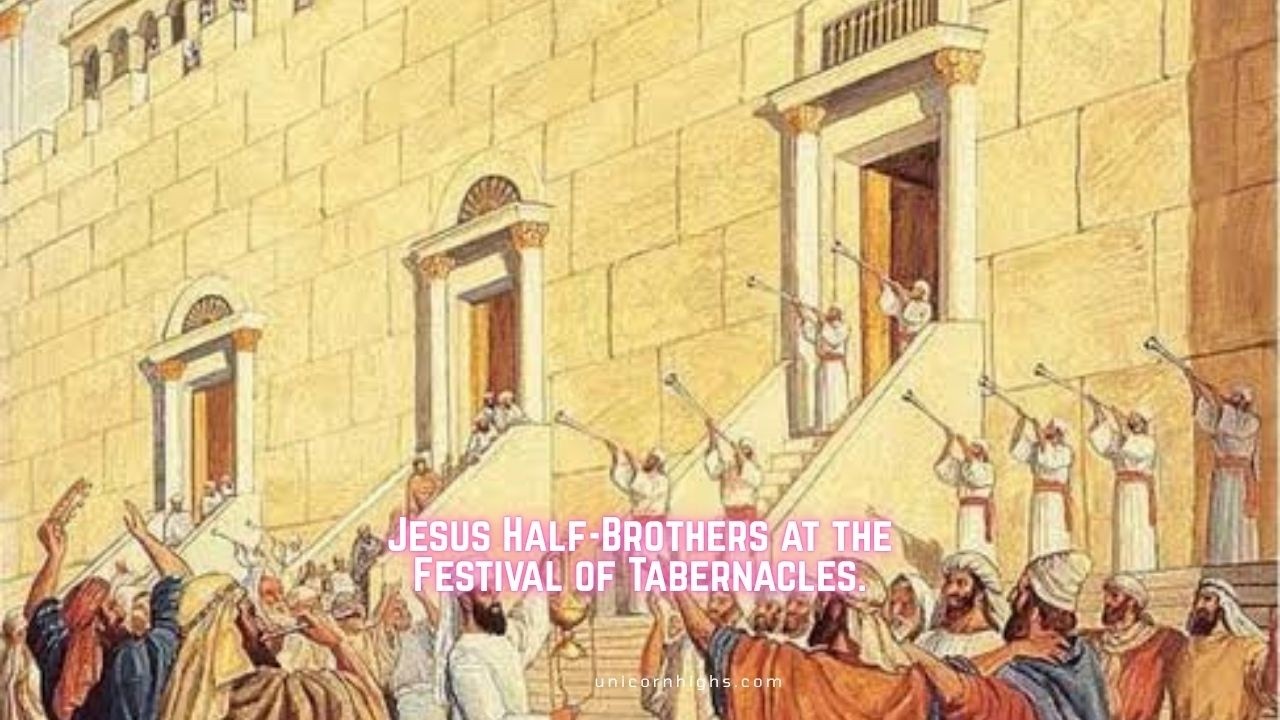
Jesus at the Feast of Booths in Jerusalem.
Did you know that the term “the Jews,” as it appears in the Gospel of John, refers to the religious authorities and adherents of Jerusalem?
Tell the Israelites, “I AM has sent me to you.” Did you know that Jesus made this assertion repeatedly? The statement “I AM” appears seven times in the Gospel of John, indicating that He is God. The Gospel of John emphasises this, noting seven of Jesus’s “I AM” declarations.
“Your father Abraham rejoiced that he would see my day; he saw it and was glad.” Jesus suggests that Abraham, a holy man, anticipated the Messiah’s arrival and “rejoiced” when Jesus’ day arrived. The original Greek phrasing suggests a profound, innate, organic understanding.
His detractors laughed at this shocking yet compelling discovery, asking, “You’re not even fifty; how can you have seen Abraham?” Because it is an exceptional statement, Jesus responds with what some call the “hidden ‘I AM'” remark. Paradoxically, this is Jesus’s most straightforward use of the phrase.
Everyone who hears Jesus declare, “I AM,” understands that He is God (John 10:33). Those who argue that Jesus never claimed to be God should consider the religious establishment’s response to His teachings. They are so furious that they immediately try to stone Jesus (John 8:59).
Did you know these seven names of Jesus?
Jesus’ public ministry begins and ends in John chapters 7 and 8. In these verses, He publicly refutes the Jewish leaders’ errors in faith and reveals His involvement in humanity’s redemption. Do you know this fact?
Did you know the seven names for Jesus in the Gospel of John?
1st of John’s seven names for Jesus: “the Word.”
2nd of John’s seven names: “the Light.” V. 4 (affirming Jesus’ divinity)
3rd of John’s seven names: “the Son of God.” V. 4
4th of John’s seven names for Jesus: “the Lamb of God.” V29
5th of John’s seven names is the Greek term Christos, “Christ,” in chapter 1, verse 42.
6th of John’s seven names for Jesus: “the King of Israel.” v. 49 (Nathanael also uses it)
7th of John’s names for Jesus, and the most important, also used by Christ: “the Son of Man.” V. 51
Did you know that, apart from Jesus, no human has ever set foot on this Earth with the same or greater glory as Adam? And that nowhere in the book of Esther—from chapters one to ten—does it mention the name of God?
Praise the Lord; my soul forgets not His benefits.
Are you aware that if you serve other gods, even unwittingly, as if someone is leading you to sin? Do you understand that you are cursed? Sin can only occur when you fail to follow the Lord’s commandments; otherwise, it cannot take place.
Did you know that the disciples cannot comprehend the concept of “the church,” let alone form it, without the guidance and influence of the Holy Spirit?

Did you know who the seven “witnesses” are? These are the people who clearly say that Jesus is the Christ, the Messiah, and the Son of God. The first of the seven “witnesses” in the Gospel of John is John the Baptist (John 1:29). The others are Nathanael (John 1:49), Peter (John 6:69), the blind man (John 9:35–38), Martha (John 11:27), Thomas (John 20:28), and Jesus Himself (John 5:25; John 10:36).
Did you know that God does not instruct humans to eat animals? Indeed, in the beginning, God did not explicitly offer animals to humans for food. No animal or human died before sin entered the world. Moreover, the predator-prey relationship never existed, as human beings were not subject to physical death until after the fall.
Did you know that Jesus, the Lord, is God?
His crucifixion also represents Old Testament sacrifices. On the Day of Atonement, two male goats were offered: one was killed, and the other released into the wilderness. Jesus was taken outside the city walls to be sacrificed on the cross, to bear our sins (2 Corinthians 5:21).
The high priest would lay both his hands on the head of the live goat. He would confess all the iniquities, transgressions, and sins of the people of Israel over it. He would then put them on the goat’s head and send it away into the wilderness with a man who was ready.
Did you know that sex, therefore, is not sinful in itself?
God gives four instructions: Be fruitful (have children). Multiply (each new generation has more children). Fill the earth (populate it). Have dominion (authority and management) over all the other creatures.
The critical commands to reproduce and multiply came before the fall of man in Genesis chapter 3. In blunt terms, God created humanity with the capacity for sex and sexual reproduction and intended us to utilise those abilities.
Like all good things, sex has a proper context: marriage. This means that God created us as intentionally sexual creatures—remains. Genesis chapter 2 explains that God directly created only two humans. The rest of us would come from them, generation after generation.