His life exemplifies complete adherence to divine timing.
Despite the suggestion from Jesus half-brothers, the gospel of John portrays Jesus as relentlessly obedient to God’s timeline. Therefore, conflict with the religious leaders of Jerusalem is inevitable, and Jesus spends much of His time in Galilee, away from their direct influence. This only delays the inevitable outcome – crucifixion and resurrection.

As is often the case in the Gospel of John, the term “the Jews” refers to the religious leaders of Jerusalem and their supporters. This distinction is important for interpreting the crowd’s reactions to Jesus’ words. “The Jews,” as described here, are a distinct group from “the people.”
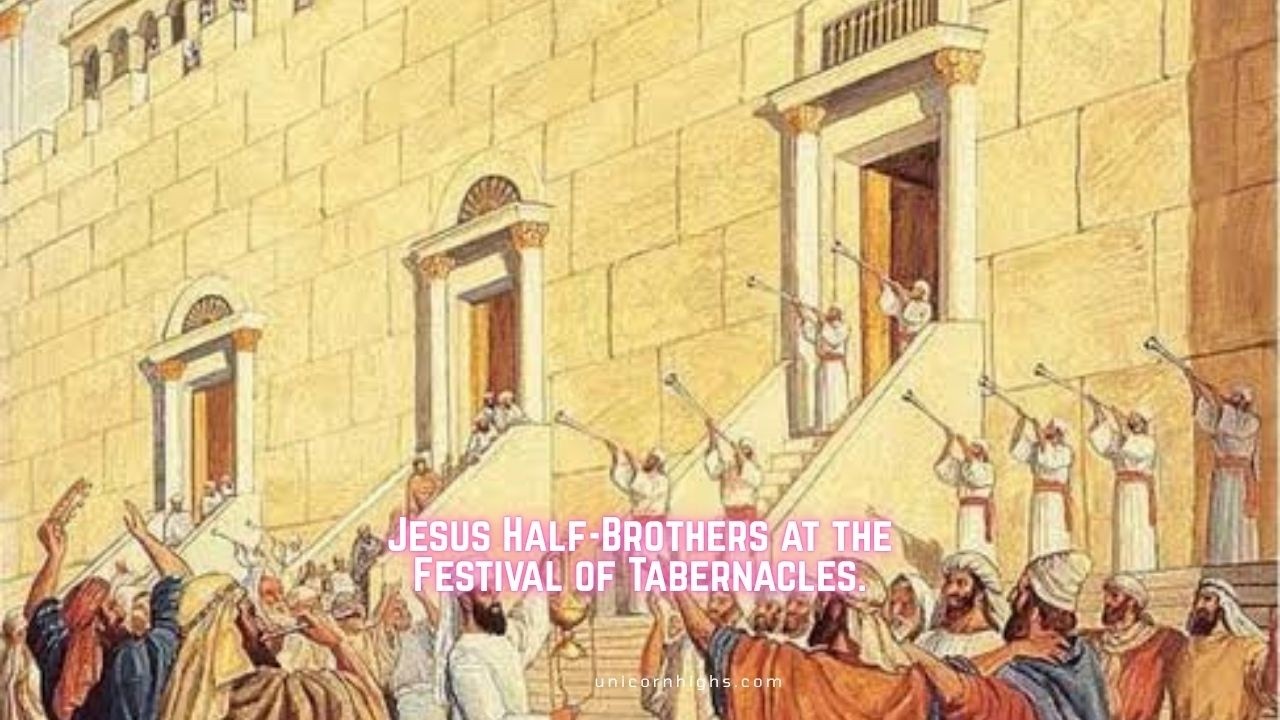
Moses commanded Jewish men to attend several feasts in Jerusalem each year (Deuteronomy 16:16). Among them is the annual 7-day festival of Tabernacles, which celebrates the end of the harvest and commemorates God’s provision and protection during the 40 years in the wilderness.
Jesus has already done enough to merit a death sentence in their eyes: they interpret His earlier actions as blasphemy (John 5:18). This desire to see Jesus killed will be inflamed by His actions at the Feast of Booths (Tabernacles).
In chapter 5, one such feast brought Jesus to the city, where He healed a man at the Pool of Bethesda (John 5:1–9). According to the timeline in the Gospel of John, that celebration would have been the Feast of Booths, the same event depicted in chapters 7 and 8.
This included enormous lamps whose wicks were made from priestly robes (John 8:12) and priests carrying water from the Pool of Siloam (John 7:37). These symbolised the pillar of fire (Exodus 13:21) and the water from the rock (Exodus 17:1–6), respectively.
At the Festival of Booths, all Israelites were required to go to Jerusalem.
As a major festival, this event would have made Jerusalem a busy, densely populated place. The conflict between Jesus and the religious leaders, as shown in this passage, would have carried even more tension because of the enormous publicity.
However, verses 3–5 offer a sombre commentary and provoke controversy. The men in question are called Jesus’ “brothers”, confirming that Mary, Jesus’ mother, had other sons and daughters. The Greek term is adelphoi, which can refer to countrymen—fellow Jews—as well as to biological siblings.
However, this phrasing also appears in verses such as Matthew 12:46 and Mark 6:3. In the Gospel of Mark, Jesus’ brothers are even named. Psalm 69:8 refers to “mother’s sons” rather than “father’s sons”.

This is the same passage that came to mind when Jesus cleansed the temple in John 2:13–17 (Psalm 69:9). In short, the only reasonable interpretation is that these were Jesus’ physical, biological Jesus half-brothers and fellow children of His mother, Mary.
At least some of their disrespect may have stemmed from familiarity. Jewish tradition held that the Messiah would be relatively unknown (John 7:27), so merely knowing Jesus was enough for some to dismiss Him as the Promised One.
As seen in the lives of men like Judas Iscariot, simply knowing “about” Jesus, or being exposed to Him, is not enough to make someone a believer.
Jesus half-brothers mock Him.
Verse 4 continues the sarcastic, mocking tone of Jesus’ brothers. Passages such as Matthew 12:46 and Mark 6:3, along with allusions to prophecies such as Psalm 69, provide every reason to think these were Jesus’ actual half-siblings: other sons of His mother, Mary.
When Jesus fed thousands, it drew significant attention (John 6:14). However, when He explained the true meaning of His ministry, most of those followers turned away (John 6:66). Perhaps this is the motivation behind Jesus brothers’ mockery: “go make a scene if you want to be such a big deal!”
Jesus, on the other hand, is only interested in following God the Father’s timetable (John 7:6). Much of what Jesus does will attract controversy. Yet publicity is not the true purpose of His actions.
To avoid unnecessary scandal and make a more discreet entrance, Jesus will let His brothers go ahead of Him so He can enter the festival alone and quietly (John 7:9–10). Notably, He will perform no miracles at this year’s feast.

Of all the people in the world who should have accepted Jesus as Messiah, his immediate family would be at the top of the list. After all, nobody knew Him as well or saw His character as clearly. Yet this very familiarity seems to have the opposite effect.
Jesus half-brothers—other biological children of Mary—don’t yet accept His ministry or mission. Part of this is cultural: Jewish tradition held that the Messiah would be relatively unknown until His emergence (John 7:27).