Home Blog Page 3

Discouragement does not come from God

The events that are recently shaking the world (coronavirus, economic crisis, etc.), as well as many other dramatic events in daily life, can lead to despair and fear for the future.

It is interesting to note that even among Catholics pessimism, bitterness, and confusion are growing, both due to material difficulties and, above all, spiritual ones.

This is largely due to the many persecutions that Christians, and especially Catholics, must constantly suffer: derision, disrespect towards religion, false doctrines, heresies, anti-Christian laws, and so on.

It almost seems as if the world has never been as hostile as it is today. Today, when hypocrisy is rampant, do-goodism is the current of thought according to which – as Chesterton said – the Christian must respect everyone and everything except Christianity itself.

This situation is causing an ever-increasing state of anxiety among many believers, as well as the spread of catastrophic news and phantom prophecies that take away hope.

Faith thus turns into a dangerous superstition that has nothing to do with a true love for God the Father. Sooner or later, we will all have received one of those disconcerting “chains” via Whatsapp, according to which “if you say so many Hail Marys you will receive this or that” or one of those images portraying the Madonna that must be sent “to ten people, including me, so as not to interrupt this chain, and if you don’t do it, *insert a random catastrophe* will happen”.

Some do it as a joke or for a laugh, but others, unfortunately, really end up reducing faith to these senseless practices, or – even more dangerously – to giving credence to this or that seer, to this or that prophecy.

Let us therefore clarify these things by entrusting ourselves to the Master, to Jesus, who told us everything we need to know.

Anguish does not come from God

God is a refuge for those who have anguished hearts and gives hope to those who are afraid. This liberation from turmoil occurs in those who trust in the Father and ask for his help. Finding ourselves in difficulty and suffering, we rediscover ourselves as weak and broken: then we must have the humility to recognize our misery and seek refuge in the Lord, who always responds to this call.

Thus we read repeatedly in the Psalms: The salvation of the righteous comes from the Lord, and in the time of trouble he is their refuge (Ps 36:39); In the day of trouble I will cry to you, and you will hear me (Ps 85:7); when I was oppressed with anguish, your consolation consoled me (Ps 93:19).

What to do, then, in moments of anguish, disturbance, sadness?

Jesus, as well as all of Scripture, teaches us: to pray to God the Father, who frees us from anguish.

The evangelists tell us that Jesus, shortly before being captured, knowing that the moment of his Passion had arrived, began to feel fear and anguish (Mk 14:33; Mt 26:37), and, in the grip of anguish, he prayed more intensely (Lk 22:44).

If even Jesus, experiencing these things, felt the need to pray, how can we think of not doing it?
And God heard that prayer and sent Jesus an angel from heaven to strengthen him (Lk 22:43).

We cannot be immune to fear and suffering. It is humanly impossible not to feel sad in certain circumstances and it would be, indeed, inappropriate to face pain lightly.

However, remaining in anguish and despair, seeing everything negatively, harboring resentment, anger, and disillusionment, and transmitting these negative feelings that take away peace to the outside world, is a clear sign of distance from God.

It is no coincidence that the Scriptures always reveal to us that fear, anguish, and terror are the companions of the wicked, of those who, by not adhering to God’s law of love and justice, have darkened souls.

Because I called you, and you refused; I stretched out my hand, and no one paid attention; you ignored all my counsel, and refused my reproof;
I also will laugh at your calamity; I will mock when your fear comes upon you when your terror comes upon you like a storm when your calamity comes upon you like a whirlwind when your distress and anguish come upon you. (Proverbs 1:24-27)

Anguish, reiterates St. Paul the Apostle, overwhelms those who do evil (Rom 2:9), and is the fruit of darkness.

Those who have a dark heart see and judge everything according to this darkness, and no light can come from their words or their deeds.

Jesus Christ is the same yesterday today and forever

Jesus Christ is always the same, and his teachings, like the teachings of the Father, are eternal.


Jesus says: “My words are spirit and life.” 
Not knowing his words is equivalent to not knowing Himself, to not knowing the way to salvation.

And again, not knowing the Word, ignoring voluntarily and through laziness what has been given to us by God himself, places us in great danger of being led astray by “peregrine” doctrines, that is, vague, changeable, which succumb to the passing of time because of their falsity.

There is only one truth, and that is that of Jesus: “I am the way, the truth, and the life.”

These various and strange doctrines, therefore, can only lead far away, along paths that are too flat and simple, which do not make one grow, teach nothing, and do not help the soul.

But what are these doctrines? How do they present themselves? How can we recognize them?

Let us analyze the letter to the Hebrews. In the passage immediately preceding the one already cited, it says: “Remember your leaders, who spoke the word of God to you; consider carefully the outcome of their way of life, imitate their faith.”

The Fathers of the Church are distinguished, among others, by two important characteristics:

  1. they announce the word of God;
  2. they are an example of very strong and steadfast faith.

The false prophet does not announce the word of God or does so only in part. Thus we witness the proliferation of religious and lay people who, while proclaiming themselves Catholic, focus their preaching on worldly issues, without any true spiritual message.

In other cases, even where the spiritual message is present, it is watered down with one’s ideas or with interpretations that change based on the social context.

Let us think of the many priests who do not believe in hell and the devil, or who in any case fail to speak about it for fear of alienating the faithful. Or, again, of that current affectionately called “Catholic-guitarist”, which sees faith as a game, God as a clown without justice who always forgives, and the Holy Mass as a celebration focused on the entertaining man.

Such an attitude is synonymous with distance from God, from the truth, from the true Christian spirit that Jesus intended to transmit. This is the first task that Jesus assigned: to announce the Gospel to the whole world.

Those who have the truth and love for the Lord at heart are not afraid of judgment, they do not hold back for fear of offending or not respecting the canons that society imposes. Those who have the Truth at heart announce it as it is, as God proposes it, without having the proud pretension of knowing better than the Creator what is right.

Why are these false prophets so harmful?

Because, with their false doctrines, they risk leading those who listen to them down the wrong path, distancing them from the sacraments and from those truths of faith that must be embraced to grow ever more in the love of God.

From here comes the second characteristic, which is, exemplary faith.

It is easy to understand that those who speak well, to be credible, must personally set a good example. This does not mean being perfect or never falling, and it is precisely for this reason that the best quality, indeed, indispensable, for spiritual progress is humility.

God, as we know, moves inexorably away from the proud. The humble, on the other hand, recognizes his misery and accepts the paternal rebuke. Humility is therefore not a lack of self-esteem or senseless do-goodism that tolerates everything.

Humility is this recognition of one’s smallness before God, such as to become children who entrust themselves totally to Him. The humble person can therefore be decisive, determined, and just, without failing in his mission.

Too often, goodness and humility are confused with weakness; a glance at the lives of the greatest saints would be enough to realize that, in reality, humility is always present even in the impetus of Saint Paul, in the wisdom of Saint Augustine, in the spiritual intelligence of Saint Teresa of Avila.

These demonstrate what the letter to the Hebrews seeks to teach: the center of Christian life is the word of God and the faith that is strengthened by it. Only in this way can we gain the comforting awareness that Jesus is always the same, that he does not change as the world changes, and that he does not mutate as the very fragile human doctrines do.

Jesus came to earth at the appointed time, but not only for that time but for all the future. 

So, as Solomon did, it is important to ask God, with incessant prayers, for the gift of wisdom. The ability to take that path that leads to Him, and which is increasingly difficult to find amidst the deceptive paths of the world.

Getting Married Young What I Wish I Knew

Yes, I got married at just 22 years old… At the time (not so long ago), I knew a few couples who married young (let’s say, married under 25). But I see that it’s not so rare, after all! If you, too, are on the path to marriage while all your friends are still big teenagers, or if you simply have questions about getting married earlier than most people, this article is for you.

Getting married before 25, should you avoid it?

Depending on who you talk to, you’ll sometimes come across strong opinions like, “If you get married at your age, you’re wasting your youth!” I’ve had a few comments that were that direct, but believe me, when I got engaged at just 19, I saw more worried looks than congratulatory smiles!

In some circles, it is common to marry young, even very young (at 18, for example). Conversely, in other circles, it is frowned upon. My parents had a hard time swallowing the pill, and some of their friends even told them that they would never have accepted that their children would marry so young. Times are changing; what was the norm a century ago is often seen as an error of judgment today.

In fact, of all the couples I know who married young, none regret their choice. My husband’s family is also a subscriber to early marriages, starting with my in-laws, who married at 21 and 22… and, decades later, nothing differentiates them from couples who married later (except that they are grandparents while most of their friends the same age still have young children ).

Age-related constraints

Getting married young indeed involves certain constraints that older couples do not encounter. The first of these is financial independence… If the studies are not completed, the couple is not financially independent and cannot provide for their own needs and those of their future children, which makes it very difficult to consider marriage calmly. Fair financial independence is a crucial issue and a real trap into which young couples in their 20s can fall.

This control can be observed before marriage and during the engagement, with parents sometimes imposing certain studies on their children without considering their future marriage plans. There can also be blackmail concerning the organisation of the “big day”: parents may refuse to participate in the wedding costs if it takes place before graduation, for example.

I know several couples (including myself) who got married before finishing their studies. In my opinion, this is not a problem as long as the couple has complete financial independence. Thus, my husband and I were able to manage, through work-study programs and student jobs, to pay for a significant portion of the wedding and be financially independent once married.

Leaving your parents is a real challenge.

Leaving your parents, as the Bible teaches us, is a challenge at any age. But this is especially true for young couples. When I started dating the man who would become my husband, it was a real shock to my parents, who did not expect me to get into a relationship at 18. They even admitted to me that they had considered forbidding me from seeing my future husband, which would have been easy for them because he and I did not live in the same city, and I did not yet have a license.

For many parents, it can be not easy to let their child go early. And as a child, it is also not easy to leave your parents while you still live with them and depend on them financially. I was thus torn during my entire engagement between my loyalty to my parents and the loyalty I wanted to have towards my future husband. I was still in an intense idealisation (and even idolization) of my parents, whom I was terrified of disappointing.

This can happen at any age, of course. However, when we enter a relationship before we have begun the process of distancing ourselves from our parents (which is a normal and inevitable part of life), this process is then experienced simultaneously with the formation of the couple, which is far from obvious. We must be aware of this, even if in some cases it goes very well (fortunately!).

Get support

Parents may seek to help the couple in the manner of a chaperone, worried about their children so young, and wanting to prevent them from making mistakes. However, this is something that must be avoided at all costs due to the parental control that this situation entails. The lack of confidence, frequent and regular, of young fiancés is very often used against them by their parents (more or less consciously). From help to control, there is only one step, which can be quickly crossed…

This does not mean that you should not be accompanied, on the contrary! It is essential for every couple, and even more so for a young couple. Be careful to choose someone with a broad perspective – it is challenging to be both judge and jury. A priest, a nun, or an older couple can be excellent companions, provided that they are available enough to answer your questions and take the time to listen to you.

And if I may give you a piece of advice: choose someone with whom you can speak truthfully, without pretence. Someone in front of whom you can be vulnerable. Someone who does not have preconceived judgments about the couple and life. For many engaged couples, support often focuses on discussing a few key points (such as chastity, premarital thinking, communication, etc.), while essential subjects and real difficulties are barely addressed or even avoided (parent-child relationships, couple freedom, the weight of the past, past wounds, etc.).

Christian site to find love better than Tinder

,br>

CHRISTIAN DATING SITES VS TRADITIONAL APPS

So let’s be clear, Tinder, ONCE, Meetic, Adapteunmec (yes, we know a lot of them) all have one thing in common: you can meet someone. Yes, I know it’s not incredible news, but being a Christian means seeing things in a different light, right? So, no matter which dating site you use, whether it’s Christian or not, we are convinced that you can find the right person by keeping in mind the values ​​of your faith.

Because there is a but. It is not always easy to be sure that the person opposite you is showing their true face. It is also not always easy to discuss your faith openly with a stranger, especially on a dating site where the atmosphere can sometimes be quite awkward.

We would be tempted to say yes rather than no. First, you participate in a Christian project. Second, you give your subscription money to Christians who work to make this world a little better.

WHAT’S WRONG WITH DATING SITES FOR CATHOLICS AND CHRISTIANS?

There aren’t any. But we know that love or sex are quite taboo subjects (which absolutely should not be), especially among believers.

Love is an incredible divine gift. We all agree to recognise it. However, when it comes to meeting or finding love for Christian people, we believe that it can be done on Sunday after the meeting, in our youth group, and so on, which is indeed true. Still, it is not always easy for shy people or those who are afraid of their brothers and sisters’ judgment, which can sometimes be harsh in matters of romantic relationships within the church.

Again, if you are in faith, then you will act in faith. There is no reason to be afraid to approach subjects like couples, sex, and porn… for fear that it will give ideas of sin. Being a Christian is being transformed, right? So, no need to avoid specific subjects.

Christian dating is a good thing for all those who, despite finding someone, throw themselves at the first stranger. Christian dating sites filter this very well and allow you to offer quality profiles to have a good time on a terrace in Paris or eat in a good Lyon restaurant to discover the person who has captured our attention via this Christian dating platform.

OUR TOP 3 CHRISTIAN DATING SITES

1- THEOTOKOS
Theotokos is not a recognised Christian dating site. It therefore has many registered singles and a recognised quality of profiles. More than 13 years of experience and a French-speaking Christian.

2- MOIPLUSTOI
Moiplustoi offers, in addition to its meeting proposal, real support from professional coaches. “We allow our members to be put in direct contact with us to take stock of their personal and emotional situations if necessary. This enables us to best support the various members in their pursuit of loveOur qualified coaches offer personalised coaching sessions to advise you in enhancing your image.”

3- JETUNOO
Jetunoo opens to an audience sensitive to the traditional family, marriage, and the values ​​it carries. They deeply insist on values ​​of faith, fidelity, and qualitative encounters for all those who wish to start a family.

Christian sites, such as Catholic Tinder or more classic platforms, take care of finding us love. Dozens of them will allow you to answer this question that everyone asks themselves: “Will God put someone on my path… I have been waiting and praying for so long…”.

But let’s not forget one thing. Being single is not a divine curse.

We don’t enter a relationship to fill a personal void, find financial stability, and do as everyone else does…

Celibacy is a period for the young Christian (or the less young) to be formed spiritually, to strengthen their relationship with God, and to build projects.

The couple, but more generally, Christian marriage is the image of Jesus and His church. A bond that can lead us to love until death to protect and defend the loved one.

The love of Christ in Songs of Songs Michael Reeves


The Song of Solomon includes a beautiful revelation for us. Jonathan Edwards explains that the very title, “Song of Songs,” creates in us high expectations of its content:

The name Solomon gives to this song reinforces my idea that it is more than an ordinary love song, and that it was designed to be a divine song, and of divine authority, because we read in 1 Kings 4.32 that Solomon “composed a thousand and five songs”. This he calls the Song of Songs ( Ca 1.1 ), which means that it is the most excellent of all his canticles, which seems to me to be very probable because of this title because it was a song on the most amazing subject, that of love, union, and communion between Christ and his bride, of which marriage and conjugal love are but a shadow 1.

There are two main characters in the Song of Solomon: the lover and the beloved. The lover is a shepherd king, like David ( Ca 1:4, 7 ), but he is the Son of David ( Ca 3:7 ). He stands at the door and knocks ( Ca 5:2, 3 ). In chapter 3, his litter resembles the tabernacle and the temple. Like the Lord in Exodus, he comes from the desert in a pillar of smoke (Ex 3:6), and his fragrance resembles the scents in the temple. The beloved is described as Israel in the exodus, arriving from the wilderness, “leaning on her beloved” ( Ca 8:5 ). Like Israel in Isaiah 5:1-S7, she is repeatedly compared to a vineyard and Jerusalem ( Ca 8:10-12 ). The wife is also a sister ( Ca 4:9 ): Christ is the husband and brother, but since marrying a sister is taboo according to Leviticus 18:9, it is improbable that this could describe an ordinary Jewish romance.

Song of Songs and Christ Jesus

Death usually separates lovers, but the love of these two lovers is as strong as death. Not even floods could wash it away (Ca 8:6, 7). It is as if the Song of Solomon was written primarily to describe this unique love story between Christ and the Church. And the similarity of the book as a whole to Psalm 45, which the New Testament cites about Christ, is surprising. It is therefore not surprising that the Song of Songs, like Revelation, ends with the wife calling the bridegroom.

How beautiful you are, oh my friend, like Tirtsa. You are superb, like Jerusalem, and formidable, like the soldiers arrayed under their banner… Who then is she who appears like the dawn and who is beautiful as the moon, bright as the sun, and formidable as the soldiers arrayed under their banner? ( Ca 6.4, 10, BDS.)

The wife is like an army. And it is as bright as the sun, with the reflected beauty of the moon. At first, a shy young girl (Ca 1.5-7), she is now formidable. As the face of Moses reflected the glory of the Lord, the Church reflected the incredible magnificence of the Bridegroom. The apostle Paul taught that through the Spirit, believers are transformed into the image of Christ “from glory to glory” (2 Cor 3:18). However, here we read that the Song of Solomon specifies that this transformation consists of growing by reflecting the remarkable aspect of Christ.

A transformed Church

Led by the Spirit in conformity with Christ, the Church begins to manifest to the world the excellent divine qualities: holiness, blessedness, happiness, fullness, and beauty. Thus, the Church shines like the moon in the darkness, arousing both wonder and fear. Believers become like the solid people who live in paradise in CS Lewis’s The Great Divorce: their wholeness and loving joy are fearsome in the eyes of others. This mixture is beautiful and inexplicable, but at the same time disturbing to unbelievers because of the way it reveals their corruption and grumpiness. In the fear of God, believers become, like their God, happily and magnificently formidable.

With what body did the resurrected Jesus appear to his disciples


The nature of the body with which Jesus resurrected is not an indifferent question for the Christian, because it is with a body similar to that of the Resurrected One that we too will resurrect.

Risen from the dead, Jesus appears to his disciples. Now, in the Gospel of the Third Sunday of Easter, it is written that some of them believe they see in him a spirit devoid of body ( Lk 24:37 ). To disabuse them, Jesus asks them for something to eat. But what nature is his body during these appearances with which, after his rise from the dead, he eats with his disciples, allows himself to be touched, speaks: all operations which need a body to be carried out? Because, after his resurrection, Christ is both the same and another: Mary Magdalene and the pilgrims to Emmaus do not recognise him! Under these conditions, the question arises: with what body does he appear to them at Easter?

A body in a new condition

All the accounts of Jesus’ appearances suggest that he was resurrected with a body of his own, which belongs to him and individualises him. However, this body, if it is indeed its own, is now in a completely new condition of life, a new state which frees it from the biological conditions of our earthly life by allowing it to modify its forms of manifestation. Furthermore, this same body is no longer subject to space-time: it manifests itself where it wants and when it wants. Is this still a human body? Yes, the body of the Risen One is indeed human because it serves as a mediation for him to manifest himself to others according to the human process of interpersonal communication, which is ours and which wants the person to express himself through his body. This is the sign of the human person: voice, gestures, gaze, etc. It is no different for the body of the resurrected Jesus.

A transfigured body accessible to faith alone

The body of the Risen One is indeed the same as that given to him by the Virgin Mary. This is the meaning of the empty tomb. Jesus resurrects with the body that was tortured on Good Friday. However, the Holy Spirit now transfigures this body; it is glorified because it has entered the divine world. Indeed, Christ was not glorified only in his spirit but also in his body. This bodily transfiguration allows him to enter into communication with all men because he is now beyond the limits of space and time.

Moreover, the sacramental presence of Christ in the Eucharist would be incomprehensible without the transfiguration of his body. It is through the mediation of his glorified body made sacramentally present by the effective sign of the consecrated bread: “This is my body which is for you” ( 1 Cor, 11,24 ), that Jesus enters into communication and communion with us at Mass. Like the presence of Christ in the Eucharist, the mystery of the glorified body of the Risen One is located at a level of knowledge and perception that is not that of our usual sensory perception. Additionally, this mystery presupposes an understanding of faith given by the Holy Spirit (Jn 6:63). The resurrection of Jesus is not a return to his previous state of life, in which case our senses would be able to apprehend it. The Resurrection is, on the contrary, the transformation of one’s carnal being into a being of glory, totally spiritualized by the Spirit.

A body that particularises Jesus

But the body of the Risen One constitutes his own body, a body which distinguishes him and by which he is recognized by the gesture of sharing bread at Emmaus ( Lk 24:31 ) or by his voice in calling Madeleine by her name: “Married !” ( Jn 20:16 ). Voice and gesture of sharing bread: it is indeed the body of Jesus which performed these two acts – acts which belong only to him since it is through them that his disciples end up recognizing him. Indeed, our voice distinguishes us, as do certain gestures and certain bodily attitudes. Our voice recognises us. Through our bodies, we are all unique. Some gestures belong only to us. It is the same for the Resurrected One. His body is indeed his own, yet it is different from what it was before, when Jesus shared our mortal condition…

Eternal life is not an undifferentiated ocean.

Mystery of a spiritual body — an oxymoron! — which anticipates the mystery of our future and eternal life in the Kingdom… We will then be freed from earthly limits (and from our selfishness!), transfigured by the Spirit while remaining ourselves. We will not merge with Brahman, the impersonal Absolute of Hinduism, because the divinity which will then welcome us is a communion of three divine Persons: Father, Son, and Spirit, not an undifferentiated ocean. This is why our spiritual body will allow us, like that of Jesus, to enter into communication with God and other elect with our personality.

Why the resurrected Jesus keeps his wounds


By showing his wounds to his disciples, the resurrected Jesus affirms that all our sorrows, sadness, and wounds are taken seriously.

“Misfortune cannot touch you”, assures Psalm 90, but how can we overcome evil and suffering after Jesus ’ victory over death? The light of the wounds of the resurrected Jesus illuminates the meaning of this wonderful psalm: “Yes, the Lord is your refuge; you have made the Most High your fortress. Misfortune cannot touch you, nor danger come near your home.” The text resonates as an invitation to experience our pain, our sorrows, and our suffering in the same way that Christ himself went through them during his Passion.

Let yourself be overcome by evil without succumbing to it

Choosing to follow Christ will not prevent us from being confronted with evil or suffering during our lives, but on the other hand, relying on Him with confidence will allow us to let evil pass through us without succumbing to it. -himself, as Christ himself allowed himself to be overcome by evil, pain, and injustice during his Passion, without refusing them. Neither protest nor recriminate. Evil had no hold on him. Not the shadow of a hook. Not a shadow of a bad answer. Evil remained powerless. Vain. Isn’t this how we can emerge victorious from the many confrontations to which we are subjected throughout our lives? It is not up to us to eradicate evil, but it is up to us to leave no hold on it within us.

Choosing to follow Christ will not prevent us from facing evil or suffering in our lives.

The fact remains that among us, fishermen, the corner, the flaw of sin is deeply inscribed in our hearts… favouring the entry of the bad. Likewise, our lives are marked by sorrow, illness, and mourning. We must therefore fight every day, every moment, only sometimes to survive. Resist. Survive. “God help me, Lord help us”, tirelessly repeats the liturgy of the hours.

Jesus respects our sorrows.

Keeping our wounds for eternity is a powerful reminder that God has come to experience our suffering. “I am with him in his trial,” says the psalm. By showing his wounds to his disciples, the Lord affirms that all our sorrows and wounds are taken seriously. Whatever they are, they are never minimised or erased. They are considered and respected to the point that Christ does not erase them from his glorious body after his resurrection.

Carrying our wounds for eternity is the outstretched hand of Christ, who tirelessly waits for us to be ready to be raised near him. The Lord does not erase our wounds; he comes to inhabit them. If we let him get close. He took upon himself the suffering, injustice, and sin of the world. In the garden at Gethsemane, he chose to drink the bitter cup of absolute injustice. Out of love for each of us. In his Passion, it was our sorrows and our humiliations that he carried with us. Under a yoke, there are two places. Bearing the yoke with the Lord also means knowing that you are never alone. He came precisely for this, to make us his brothers and offer us Salvation.

With immense gratitude

Let us remember, in the heart of our sorrows and with confidence, that from the height of his suffering, he gives us his mother, the Most Holy Virgin Mary. He also offers us his infinite mercy without measure and equivocation as long as we ask for it with sincerity. He invites us to share his body and his blood. He also leaves us his Word and gives us his Spirit.

It is with these precious weapons that we must lead our lives. And our efforts are tinged with hope since he who is the Way, and who therefore opens the way for us, leads us towards consolation. Confident and full of hope, let us contemplate the wounds of Christ with immense gratitude and absolute confidence, as a powerful reminder that the path of goodness is that which courageously chooses, despite sorrows and wounds, truth and justice rather than the ease of selfishness, indifference, or conformism.

Jesus never did things in half measures.


A sense of measure is a virtue, but can truth accommodate this sense of measure? With Jesus, if the truth is often uncomfortable, it is precisely because it goes beyond measure.

Jesus never asked you to tithe.

“How unfortunate for you, Pharisees, because you pay tithe on all the plants of the garden, like mint and rue, and you miss the judgment and the love of God”( Lk 11:42 ). By the standards of contemporary sensitivity, Jesus is inaudible. He goes beyond measure. As they say today, “It’s overkill.” But in terms of the criteria currently in force among Catholics too. We could criticise Jesus for making comments that are not “sufficiently adjusted”. In other words, our society, that is to say, also ourselves, blame him for saying angry things. Of not being measured enough. This is also what led him to the cross: his words ended up being judged intolerable in the literal sense of the term. And yet…

However, reasoning is reasoning, and talking about measured reasoning does not make much sense: measurement refers to a quantitative aspect, not a qualitative one. Applied to reasoning, measurement is nonsense and the mask of self-censorship. Nonsense because what is true is true – a qualitative issue – and not 50% or 80% true: in this case, we are in the domain of probability calculation, not in reasoning which has truth as its object.

The meaning of measurement: a prudential criterion, not truth

When we reason, we must weigh the words we use to express our thoughts, be coherent, stick to reality, and constantly seek the truth. But we are not trying to develop “measured” reasoning. At most, we can seek to have a “measured” discourse whose objective is not to tell the truth but to be accepted by people professing opinions and defending varied interests. But it is no longer a reasoning which seeks to understand reality. In this case, we are simply trying to create a consensus, to reach an agreement.

Seeking what is true is an absolute duty; seeking to be “measured” is a relative duty.

It is an approach that can be legitimate, depending on the circumstances, if there is at least a consensus or agreement around a truth, rather than an injustice. Seeking what is true is an absolute duty; seeking to be “measured” is a relative duty. Not exceeding the limit is possibly a mark of good education, but it is not a criterion of truth. If the truth is often uncomfortable, it is precisely because it goes beyond measure… that is to say, ours. By definition, truth is not subjective. Contrary to our opinions.

The truth sets us free because it is subversive.

What is true is true, even if it is not consensual. Moreover, if the truth can set us free, it is because it is subversive and goes beyond the limits of what we are prepared to tolerate, because it shatters our conventions. Trying wherever possible to express things in a “measured” way is laudable. And all the more so since the more subversive what one has to say is in substance, the more one must be irreproachable in form. As far as possible, otherwise, we fall into lies.

Let’s make measured discourse an absolute duty. We are promoting consensus within a social group, a community, or a corporation to the detriment of a truth deemed secondary or even subversive. It’s preferable to be wrong with Sartre than right with Aron. It is preferring injustice to disorder. It is preferable to condemn Socrates, Jesus, Joan of Arc, or Captain Dreyfus in the name of a consensus.

The truth or the denial

We cannot both call a spade a spade and do so in a measured manner because, ultimately, we only have the choice between recognising the truth and living by it or refusing it and living in denial. “For the word of God is living and effective, sharper than any two-edged sword, piercing to the point of dividing soul and spirit, joints and marrow; she judges the feelings and thoughts of the heart. No creature is hidden from him, but everything is bare and open to the eyes of him to whom we must give account” ( Heb 4:12-13 ). Jesus exceeds the measure. And the U.S?

The miracles of Jesus the healing of an epileptic


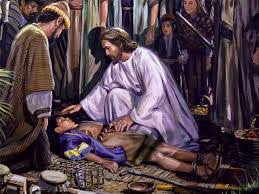
The three Evangelists, Matthew, Mark, and Luke, report a curious healing, that of an impressive illness manifested by crises described as “worthy of madness” according to the words of the latter. This healing by Jesus took place the day after the Transfiguration, as Jesus came down from the mountain accompanied by his disciples. On this path, He was addressed in these words by a desperate man: “Master, please look at my son, because he is my only child, and it happens that a spirit takes hold of him, pushes suddenly screams, shakes him with convulsions and makes him foam; he only moves away from him with great difficulty, leaving him completely broken” ( Lk 9:38-39 ).

The description of the evil leaves no doubt for modern medicine, the convulsions and the foam on the lips of the patient reveal an epileptic attack, an illness qualified in the time of Jesus as that of an evil influence of a mind on the patient. Ancient doctors considered, in fact, this illness as an attack on the “sacred substance” itself, where the soul resided. Curiously, the father of the child specifies that he had previously asked the disciples of Jesus to expel this spirit, which, however, they were unable to do…

Healing of body and soul

Hearing the words of the Father, Jesus then spoke harshly to the crowd – and perhaps also to his disciples who had not had sufficient faith to heal the epileptic: “Unbelieving and misguided generation, how long will I stay close to you and support you? Bring your son forward here.” We know that Jesus never ceased to invite prayer as a means to escape from unbelief and strengthen faith. This very faith can move mountains (Mk 11:23). But once again, He must, in the face of this wavering faith, prove that nothing is impossible for God, even in healing the most terrible evils.

So Jesus immediately turned to the sick young man for a fight with the evil spirit, the latter then seeking to overcome his victim by increasing his suffering with atrocious convulsions. But Jesus threatened the impure spirit which left the child, definitively healed and returned to his father. It is not only a healing but also an exorcism that the biblical story describes to us, a sign once again that these two dimensions were closely linked at the time, to the great astonishment of the crowd present “before the greatness of God,” underlines the Bible.

Healing reported through the arts

This impressive scene has left its mark, and artists have often captured it in numerous works, such as the famous Très Riches Heures of the Duke of Berry from the 15th century. This well-known manuscript, preserved at the Chantilly Museum, constitutes a prayer book that Duke John I of Berry initially ordered in 1411 from the brothers Paul, Jean, and Herman de Limbourg, and which was subsequently completed by other, equally famous artists. such as Barthélémy d’Eyck or even Jean Colombe.

A true jewel of Gothic art, this manuscript reveals multiple artistic influences from Flanders, France, and Italy, but also the Orient and antiquity. This emblematic work of the Middle Ages thus captured this miracle of Jesus, that of the epileptic, represented with a luxury of detail that commands admiration. The scene takes place not outside but on the threshold of a synagogue evoked by a rich temple with slender vaults. Lapis lazuli competes with carmine red in shimmering colours, highlighting the abundance of details of this impressive scene. The Jews are depicted as Ottomans while the sick young man dressed in rags writhes in pain and convulsions. An evil spirit hovers over him, turned towards Christ, who tells him to get out of the body of the child, whom his father is barely supporting because he is so desperate… This artistic evocation succeeded in a short space of time in representing the essential, Jesus came to earth to convert the hearts of women and men and save them from all their evils…

Several religions one truth how to discern.


Some conclude that they are all equal in their dangerous claim to monopolise the truth, that they are all equally inclined to intolerance and as such dangerous, and that it is better to adopt towards them a hostility of egalitarian principle. The most coherent among them consider it necessary to fight politically and ideologically against their influence with the same uncompromising determination as when undertaking a rodent control campaign. They are the heirs of the Enlightenment.

She is crazy because it is a delusional presumption to unilaterally decree that all the spiritual experience accumulated by humanity since its appearance is incapable of teaching them anything.

It is radically false because its presuppositions are false: it is not true that all religions claim a monopoly on truth and that the guarantees they provide are equivalent. A typology of religions, even a summary one, is enough to demonstrate this.

Most religions do not claim to reveal the truth.

Hinduism, a religion whose founding myths are lost in the mists of time, does not claim the exclusivity of the truth. Passed down from generation to generation, its founding stories are not under the supervision of any identified authority. This does not prevent certain Hindus, like men of any religion, from persecuting those who do not share their faith (Christians and Muslims).

Buddhism, Confucianism, and Taoism are all wisdom of life founded by great masters of wisdom (Buddha, Confucius, and Lao Tzu) who are not strictly speaking religions in the sense in which we understand them. They do not claim to reveal the truth but to constitute an art of living intended to succeed in one’s existence here on earth. They do not tell us about the meaning of our life here on earth and our possible life after death.

Animist religions – and in particular those which include human sacrifices as in the case of the worship given by the Carthaginians to the god Baal or that which the Aztecs paid to the sun god – aim to preserve an always precarious cosmic harmony, to purchase social peace with the dark and evil forces of the universe by keeping them at bay. They are neither concerned with certifying their divine origin nor with responding to a quest for meaning. The question of truth does not concern them.

Some religions are what we would call “secular religions” which deify the political system… and reinforce the authority of those who run it: this was the case of the Incan, Egyptian, and Roman empires, and this is still the case of Shintoism in Japan. And in a sense, this is also true of atheist religions like Nazism or Communism which we saw flourish in the 20th century. The truth is not their concern either. Theirs are more prosaic: maintaining social cohesion and strengthening the legitimacy of the existing power.

Syncretic religions ( New Age and sects) are the product of a marketing approach aimed at offering the public a new product corresponding to their expectations. This is not the result of a quest for truth. Only the revealed religions (Judaism, Christianity, Islam, Mormonism) claim to reveal and transmit a truth of which they are not the inventors. The divine origin of their content, which they all claim, is the guarantee of the authenticity of the message and they all present themselves as faithful messengers who have added nothing nor taken anything away from the original divine truth.

Only revealed religions claim exclusivity of truth

The heirs of the Enlightenment are mistaken and therefore deceive their world by asserting that all religions claim the exclusivity of truth: this is simply false. The question of truth is only central for religions that present themselves as revealed religions, and these are few.

It is for them, and for them alone, that the question of the authenticity of their divine origin arises. But this does not mean that the question is insoluble. We can apply to this revelation the methodology used daily by journalists, historians, police investigation services, and intelligence services: the cross-checking of sources.

The criterion is simple: do these religions present themselves as the product of a private revelation, attested by a single individual and by definition unverifiable, or of a collective revelation, attested by several individuals? In other words, can we cross-check the sources? This criterion allows for the exclusion of Islam and Mormonism, but not Judaism or Christianity.

In biblical revelation, it is through patriarchs, priests, kings, prophets, and the Messiah, who lived at different times, that the word of God was spoken, events were prophesied, and prophecies were fulfilled.

In the New Testament, we have four distinct testimonies (the four Gospels) which correspond in broad outline and differ only in detail. Precisely as the historians’ sources tell us the history of Rome, it is not a guarantee of truth, it is not proof: it is a guarantee of plausibility.

Converging clusters of evidence, not proof

The absence of proof, in the scientific sense of the term, is sometimes a source of skepticism for many undecided people and even for believers. However, it is precisely this that is surprising: the absence of proof is regrettable, we can admit.

But why would that be problematic? After all, who married their partner after he had proven his love for them? Person.

We get married because someone declares their love for us and we trust them based on a certain number of converging clues and our intuition, which Pascal called the heart and which understands without being able to demonstrate: the heart has its reasons that reason ignores.

Who has ever followed a doctor’s prescriptions because the doctor had previously demonstrated the accuracy of his diagnosis and proven the accuracy of the treatment he recommended? Person.

We possibly trust a doctor based on what friends or acquaintances tell us, whose testimony also seems trustworthy to us.

Generally speaking, we spend our lives making decisions based on incomplete and imperfect information, that is to say, without having proof, without having absolute certainty.

We typically do this based on probability, relying on converging clusters of evidence rather than relying solely on individual pieces of evidence. At some point, we decide to place our trust in someone. In the literal sense of the word, we give him our faith. What we do every day in all areas of life with the people around us is not absurd. So, why would what we do with them be absurd in the eyes of God?

�[O�����\�X�۝Z[�\�ٛ۝ \�^�N� M���۝ ]�ZY�� �[�KZZY�� K�N���܎�ٙ����۝ Y�[Z[N��[�\���[��\�\�Y��H ����\�[[������][ێ�X���]N�Y[�Ό�X\��[��L\��\��X� N�Y�� NNNNNN\��]K\�X�N���ܘ\؛ܙ\����۝ \�^�N� M���� NNNNNN\��۝ ]�ZY�� �[�KZZY�� K�N���܎�ٙ����۝ Y�[Z[N��[�\���[��\�\�Y��O ��[O
×

Cart

Your Cart is Empty

Back To Shop